
The Inference Substitution Problem
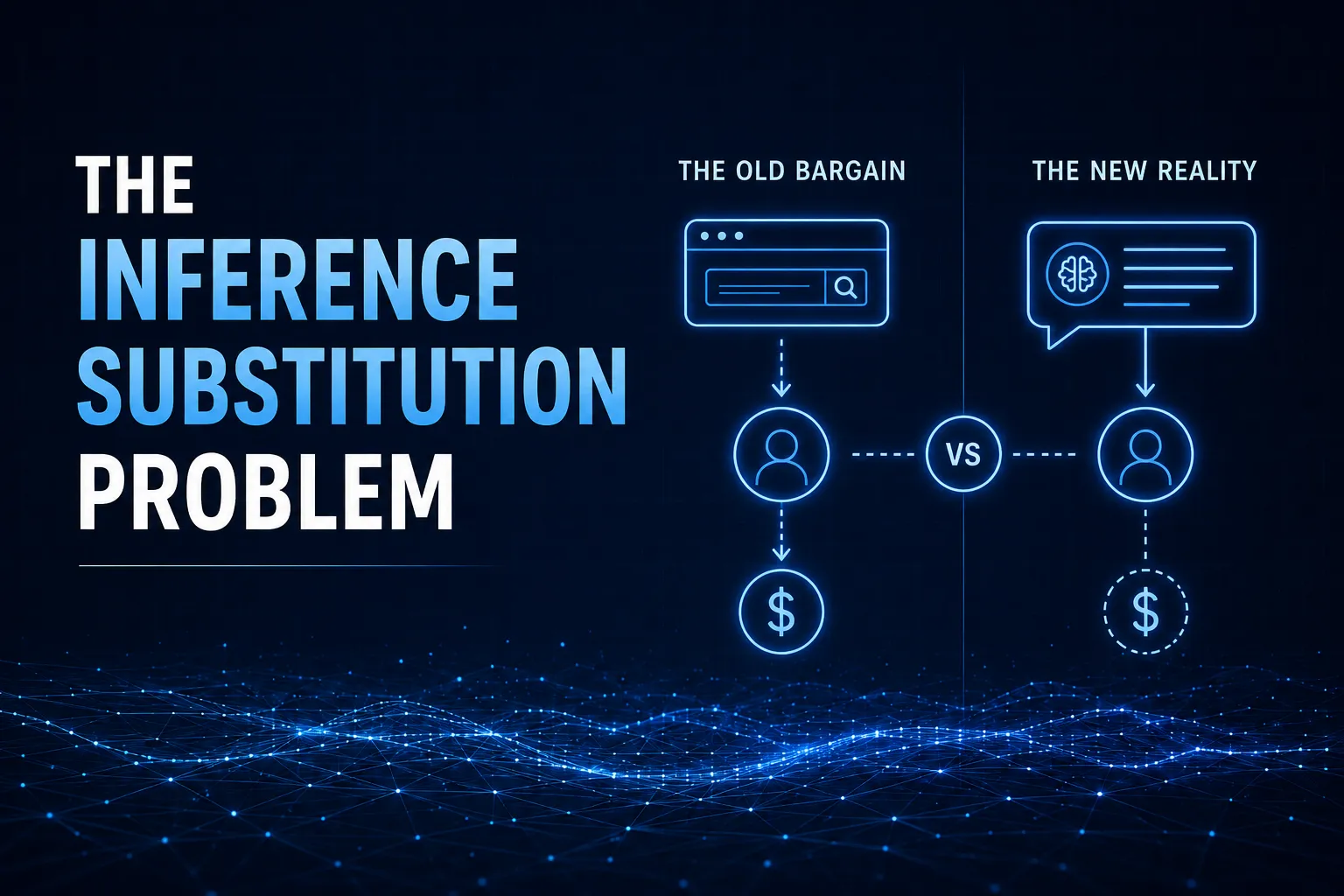
Search engines indexed content and sent traffic back to publishers. That was the implicit bargain of the search economy. Publishers accepted crawling because crawling produced referrals, and referrals produced revenue. The economics were imperfect, but the direction of value was at least partially reciprocal.
Inference substitution breaks that reciprocity. When an AI system retrieves, processes, and synthesises content to generate a direct answer, it does not send the user back to the source. The user's need is satisfied inside the interface. The publisher's content contributed to that satisfaction, but the publisher received nothing because there was no click, no visit, and no transaction.
This is not a marginal edge case. It is the core product behaviour of every major AI interface currently deployed at scale. The better these systems get at answering questions directly, the more completely they substitute for the original source. That creates a structural tension between AI product quality and publisher economics that the market has not yet resolved.
Defining inference substitution
Inference substitution occurs when an AI model uses protected or proprietary content at runtime to generate an output that satisfies a user's need, and that output reduces or eliminates the user's motivation to access the original source.
The key word is substitution. Not all AI use of content is substitutive. A system that surfaces a link and a short excerpt alongside a recommendation is directing the user toward the source. A system that produces a complete answer, summary, or synthesis that leaves no meaningful reason to click through is substituting for it. The distinction matters because the economic consequences are different. Discovery-oriented AI use can sustain or even increase traffic. Substitutive AI use redirects demand away from the source entirely.
The inference licensing framework exists precisely because substitution happens at the inference layer, at the moment a model generates output from retrieved content, rather than at the training layer. A training license governs what goes into building a model. An inference license governs what the model does with content every time it runs. Because inference is continuous and high-volume, the substitution effect compounds over time.
Why the substitution effect is economically significant
A single substitution event has negligible economic impact. At scale, the effect is material.
Consider a publisher whose content appears regularly in AI-generated answers across a major platform. Each answer that uses their content and satisfies the user without a click-through represents a lost pageview. Lost pageviews mean lost advertising impressions, lost subscription prompts, and lost affiliate events. The content is doing work. The publisher is not being paid for it.
Research from the Reuters Institute consistently shows referral traffic from search as one of the most commercially significant inputs for digital publishers. As AI interfaces absorb more of the query volume that previously flowed through search, that referral traffic is at risk. The substitution does not have to be complete to be damaging. Even a partial reduction in click-through rates across a large query volume represents meaningful revenue erosion for publishers who depend on traffic-based monetisation.
This dynamic is also not hypothetical. Studies tracking click-through rates from AI-augmented search results have found measurable reductions in organic clicks when AI-generated summaries appear at the top of search pages. Google's own rollout of AI Overviews has been accompanied by significant industry discussion about the traffic implications for publishers. The substitution effect is already being measured. Its economic consequences are already being felt.
Where substitution happens
Inference substitution is not a single mechanism. It occurs across several different AI product types, each with different substitution characteristics.
In conversational AI interfaces, substitution is most direct. A user asks a question, the model generates a comprehensive answer drawing on retrieved or trained content, and the conversation ends without any referral to source material. The user may not even know which publishers or creators contributed to the answer they received.
In AI-augmented search, substitution is more partial but still significant. AI-generated summaries appear above organic results, satisfying enough of the user's intent that the click-through to the underlying source does not happen. The source is implicitly cited but not visited, which means it contributes to the answer without generating the traffic that would justify that contribution economically.
In agentic workflows, substitution takes a different form. An agent retrieving content to complete a task is not sending a human user anywhere. The content is consumed programmatically, processed as an input to a workflow, and the output is delivered directly to the user or to another system. There is no visit, no impression, and no transaction path back to the content owner under any existing monetisation model.
Each of these contexts requires a different response from publishers and content owners, but the underlying economic problem is the same: value is being created from content at the inference layer, and that value is not flowing back to the people who produced the content.
The relationship to the scraping-to-revenue imbalance
Inference substitution and the scraping-to-revenue imbalance are related but distinct problems. The scraping-to-revenue imbalance describes the gap between total machine access to content and total revenue returned to content owners. Inference substitution describes a specific mechanism that drives that gap: the replacement of source visits with AI-generated outputs.
Understanding the distinction matters because the solutions point in different directions. The scraping-to-revenue imbalance calls for licensing infrastructure that captures value from access events. Inference substitution calls for licensing terms that specifically govern what AI systems are permitted to do with content at runtime, and that attach compensation to the substitutive uses that create the most economic harm.
A publisher might reasonably permit an AI system to index their content for discovery, because discovery can still drive traffic. They might want different terms, including compensation, for uses that generate direct answers from their content, because those uses substitute for the visit rather than enabling it. That distinction cannot be expressed through a binary allow-or-block control. It requires machine-readable licensing that can encode different permissions and pricing for different types of AI use.
Why training licenses do not solve the inference problem
A significant portion of the industry discussion around AI and content rights has focused on training licenses: agreements that govern whether and how AI companies can use content to build or improve their models. Those agreements matter, and several major publishers have negotiated them with leading AI companies.
But training licenses do not address inference substitution, because training and inference are different events with different economic consequences.
Training is a bounded act. A model ingests a corpus, updates its weights, and the training run ends. The content's influence on the model is indirect and diffuse. Inference is an ongoing act. Every time a model generates output from retrieved or cached content, a new substitution event potentially occurs. The cumulative economic impact of inference-time substitution can exceed the impact of training use, because inference runs continuously at scale while training happens periodically.
OpenAI's own documentation distinguishes between different types of content access for exactly this reason, separating training-related crawling from retrieval and search-related access. That separation reflects a real difference in function and economic consequence. Publishers negotiating only at the training layer are addressing one dimension of the problem while leaving the inference layer unpriced.
What inference licensing needs to cover
An inference license that actually addresses substitution needs to specify more than whether an AI system is permitted to access content. It needs to address the type of use, the form of output, and the compensation mechanism that attaches to substitutive uses specifically.
At minimum, a functional inference licensing framework should distinguish between access for discovery and access for direct answer generation, because the economic consequences are different. It should specify whether summarisation is permitted, and if so under what conditions, because a summary that satisfies user intent without a click-through is substitutive in a way that a link and excerpt is not. It should address caching and retention, because content stored for repeated inference use creates ongoing substitution without repeated compensation. And it should attach a compensation trigger to the events that create the most economic harm: the generation of outputs that directly replace source visits.
Expressing these distinctions requires structured, machine-readable terms. Legal agreements written for human review cannot operate at inference speed and scale. The permissions, constraints, and pricing conditions that govern substitutive AI use have to be readable by software at the point of access, which is why standards like RSL and the infrastructure built around them are a necessary part of any realistic solution.
Why this problem will intensify
Inference substitution is not a static problem. It will intensify as AI systems improve and as agent-based workflows become more prevalent.
Better models produce more satisfying direct answers, which increases the substitution rate per query. More capable retrieval systems access more content more frequently, which increases the volume of substitution events. Agentic systems that complete tasks on behalf of users generate substitution across entire workflows rather than individual queries, removing the user from the content consumption loop entirely.
The trajectory is clear. As AI systems become more capable, the substitution effect grows. As the substitution effect grows, the gap between content consumption and content compensation widens. Addressing it requires infrastructure that can price substitutive access and settle compensation at the rate inference actually operates, which is continuously and at scale.
What a workable response looks like
Publishers and content owners who want to address inference substitution need to do three things: declare what uses are permitted and which require compensation, enforce those terms at the access layer, and connect enforcement to metered settlement.
Supertab Connect is designed to make all three steps operational without requiring publishers to build custom infrastructure. It translates licensing policy into machine-readable RSL terms, enforces access at the CDN edge, and connects permitted usage to the settlement layer so that compensated inference access can be priced and paid. For publishers who already have AI licensing agreements, it converts those agreements into enforced, auditable access controls rather than leaving them as paper commitments with no technical backing.
The inference substitution problem will not be resolved through litigation alone, or through blanket blocking, or through informal norms about what AI companies should and should not do with content. It will be resolved when the market has infrastructure that makes licensed, compensated inference access the default path, because that path is easier to use than the alternative. Building that infrastructure is the practical challenge the industry now faces.
What inference substitution really means
Inference substitution is the mechanism by which AI systems convert content into value without returning that value to the content owner. It happens every time a model generates an answer that satisfies a user's need without sending them back to the source. It compounds over billions of queries. And it represents the most direct form of economic harm that the AI era has introduced for publishers, creators, and data providers.
The solution is not to prevent AI systems from using content. It is to ensure that when they use content in ways that substitute for the original source, that use happens under terms that include compensation. That requires licensing infrastructure capable of operating at inference speed, expressing granular permissions, and settling payment automatically. The market is moving toward that infrastructure. The pace at which it arrives will determine how much value is permanently lost in the meantime.


