
What AI Monetization Means for AI-Powered Search Platforms
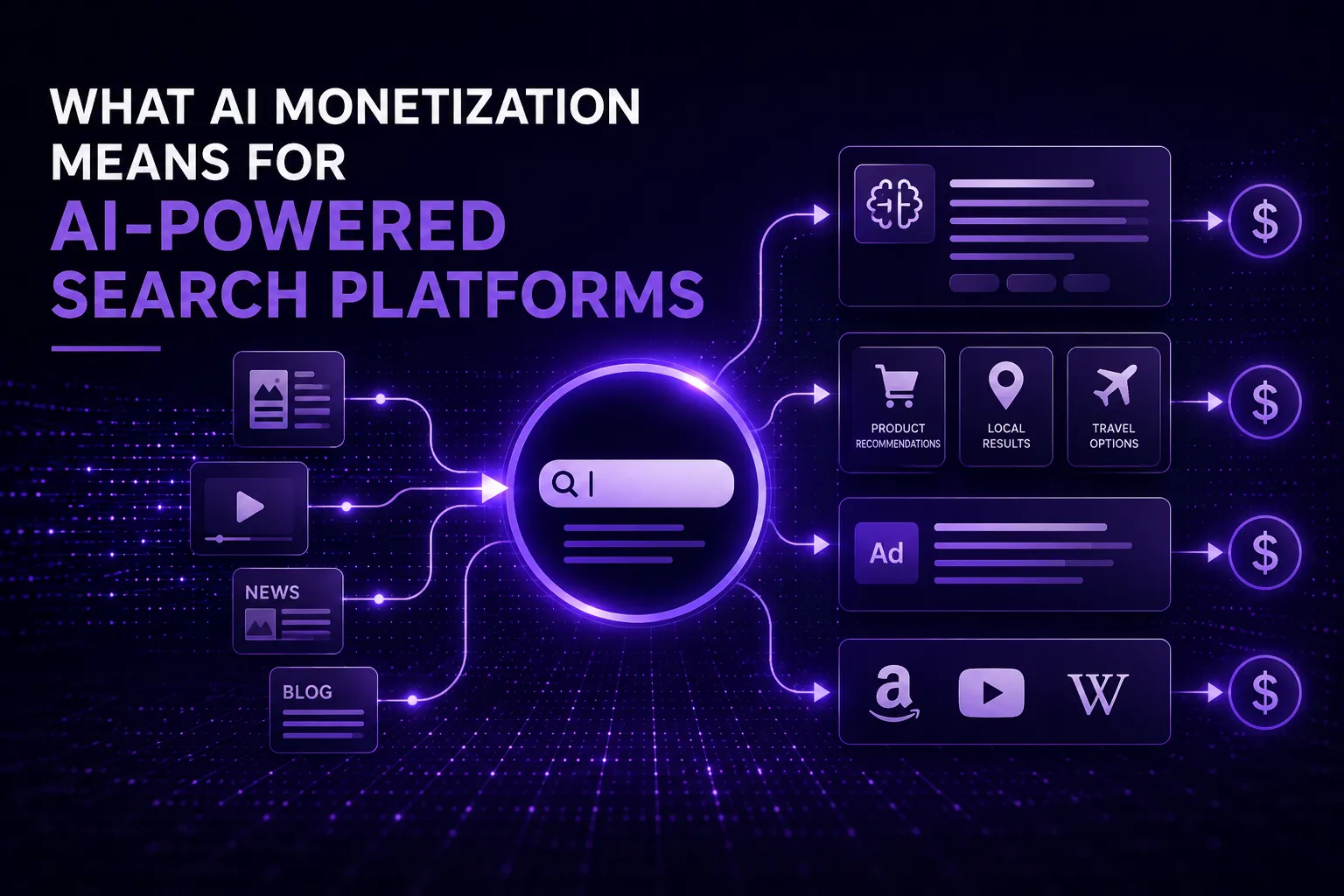
AI-powered search platforms occupy a distinctive position in the digital economy. They sit between content producers and the audiences those producers depend on, and they have become increasingly capable of satisfying user intent without completing the referral that once made that mediation economically neutral. Google's AI Overviews, Microsoft's Copilot integrated into Bing, Perplexity, and a growing set of enterprise search products all share a common architecture: they ingest, retrieve, and synthesize external content to generate direct answers, and they do so at a scale and speed that manual browsing cannot match.
For users, this is genuinely useful. Queries that once required visiting three or four sources can be resolved in a single interface. For the content owners whose material powers those answers, the economics are considerably more complicated. The platform captures the attention event. The publisher absorbs the production cost. The compensation mechanism connecting those two facts remains underdeveloped across most of the market.
That gap is not only a publisher problem. It is a structural challenge for the search platforms themselves, because the quality of their answers depends on the continued production of the content they retrieve from. If content providers cannot sustain the economics of production, the retrieval layer degrades. The incentive misalignment is real on both sides.
How AI search differs from traditional search economics
Traditional search created a referral economy. The platform indexed content, surfaced relevant results, and sent users to the source. Publishers captured value through the visit: advertising revenue, subscription conversion, affiliate performance, and first-party data collection. The platform captured value through advertising adjacent to results. Both parties had an interest in the click because the click was the unit of exchange.
AI-powered search compresses that model. The answer is often complete before the click. Google's own documentation on AI features in Search describes the goal as helping users understand topics faster and explore further through linked results. In practice, the exploration rate falls when the summary is sufficient. Pew Research data on AI search behaviour documents that users are less likely to click through when a direct answer appears, which is exactly the pattern that weakens the referral model publishers depend on.
The commercial consequence for publishers across every category has been covered extensively in the context of enterprise publishers, local media networks, and ad-dependent outlets. The through-line is the same: when the visit does not happen, the monetisation event does not happen either, and AI search platforms sit at the centre of that compression.
The content dependency that search platforms rarely discuss publicly
AI-powered search platforms are structurally dependent on external content in a way that distinguishes them from other AI products. A foundation model can, in principle, generate responses from parametric knowledge alone. A search platform cannot. Its value proposition is specifically tied to retrieving current, accurate, and diverse external information. Without continuous access to fresh content from credible sources, the answer quality that makes the product useful deteriorates.
This dependency is not symmetrical. Content producers bear the full cost of creating, maintaining, and publishing accurate material. The search platform bears none of that cost but captures the attention value when the content is used to answer a query. That asymmetry has existed in modified form since the early days of web search, but AI interfaces have widened it considerably because the content is now consumed inside the platform rather than previewed before a click.
The legal dimension of this asymmetry has become increasingly visible. Ongoing litigation between major publishers and AI search companies over content use without compensation reflects how quickly the informal tolerance that characterised early web indexing is breaking down. Publishers that once accepted low click-through rates as the cost of discoverability are now examining whether the terms of that arrangement still make commercial sense when the click disappears entirely.
Where the revenue logic breaks for search platforms
AI-powered search platforms face a monetisation problem that is distinct from the one they create for publishers. Their revenue model still relies primarily on advertising, but advertising economics assume that users spend time in environments where ads can be served, contextualised, and measured. A search experience designed to resolve queries quickly and completely creates less of that environment, not more.
Google's advertising revenue has remained large partly because the transition to AI-generated answers has been gradual and partly because the company controls both the search interface and significant portions of the programmatic advertising infrastructure. But the structural tension is real: the more effective the AI answer, the less time the user spends in an ad-supported environment. That is not a problem unique to Google. It affects every AI search product trying to layer advertising revenue onto an interface designed for efficiency rather than dwell time.
Subscription models are one alternative, and Perplexity has pursued a paid tier alongside its free product. But subscription conversion in search is constrained by user expectations. Web search has been free for long enough that willingness to pay for improved search is limited outside specialist or enterprise contexts. The Reuters Institute Digital News Report consistently shows that only a small minority of users pay for any digital information product, and search occupies a category where the free expectation is especially entrenched.
Enterprise licensing is where AI search platforms have found more durable revenue. Microsoft's Copilot integration across enterprise software, and Perplexity's enterprise tier, reflect a shift toward selling AI-augmented search as a productivity tool within organisational workflows rather than as a consumer product funded by advertising. That model aligns better with how value is actually created, because enterprise users are paying for accuracy, speed, and integration rather than tolerating ads in exchange for free access.
The content licensing gap at the centre of the model
The unresolved question for AI-powered search platforms is how to build a sustainable content relationship with the providers whose material makes the product work. Bilateral licensing deals have emerged as one response. Reported agreements between Perplexity and publishers including a revenue-sharing arrangement reflect a recognition that the referral model alone is no longer sufficient compensation. OpenAI's deals with publishers including the Associated Press and Axel Springer represent a similar acknowledgement at the foundation model level.
These deals matter because they establish the principle that AI access to premium content carries a price. They do not, however, scale well across the full content ecosystem. They favour large publishers with negotiating leverage. They leave smaller content providers outside structured compensation frameworks. They also do not address the ongoing retrieval question: a training data deal covers one category of use, but AI search platforms retrieve content continuously at inference time, which is a separate and recurring form of access that bilateral agreements rarely account for in full.
The gap between what bilateral deals cover and what retrieval-augmented search actually does at scale is where programmatic licensing infrastructure becomes relevant. Machine-readable rights expression allows content providers to declare retrieval terms in a format that automated systems can interpret. Monitoring creates the usage data that makes pricing rational. Programmatic settlement allows compensation to flow at the frequency that retrieval actually occurs, rather than through annual negotiations that cannot reflect usage variability.
Supertab Connect addresses exactly this infrastructure gap, providing content owners with the tools to publish machine-readable licensing terms, enforce access at the edge, and connect retrieval usage to automated settlement without requiring a bespoke commercial agreement for every AI system that accesses their content.
Cross-stakeholder friction is intensifying
AI-powered search platforms operate inside a web of competing interests that are becoming harder to manage informally.
Publishers are pushing back on uncompensated retrieval through litigation, through technical controls, and through participation in standards initiatives like Really Simple Licensing that give rights declarations a machine-readable format AI systems can act on. The shift from passive tolerance to active rights assertion is already visible across the industry.
Advertisers are watching the transition carefully. Search advertising has historically been the highest-intent ad environment in digital media because users signal what they want through their queries. AI-generated answers that resolve intent without displaying ads reduce the inventory that makes search advertising valuable. As AI interfaces become more prevalent, the premium that search advertising commands may compress.
Regulators in multiple jurisdictions are increasing scrutiny of how AI search platforms handle content. The EU's AI Act and evolving copyright frameworks require greater transparency around what content AI systems use and how they attribute it. The direction of regulatory travel is toward structured disclosure and enforceable rights, which means the informal arrangements that have characterised AI content access to date are unlikely to persist.
Users, for their part, have mixed incentives. The convenience of direct answers is real and valued. But research from the Tow Center for Digital Journalism has documented citation inaccuracies and attribution failures across multiple AI search products, which raises questions about reliability that matter to users who depend on these tools for consequential decisions.
What sustainable AI search economics look like
The search platforms most likely to maintain content quality over time are those that treat content access as a cost of goods rather than an externality. That means moving beyond informal scraping tolerance and bilateral deals toward infrastructure that can price and settle retrieval at scale.
For content providers, that shift requires capabilities they mostly do not have today: machine-readable rights signals, retrieval monitoring, and automated settlement. For AI search platforms, it requires commercial architectures that can accommodate usage-based content costs rather than assuming open access as a permanent baseline.
The usage-based monetisation frameworks that are emerging across the AI economy apply directly to search retrieval because retrieval is inherently a usage event. Each query that draws on licensed content is a discrete, measurable, attributable interaction. That makes it more tractable as a pricing unit than training data ingestion, where attribution is diffuse and retrospective.
The Referral Model Is Broken. What Comes Next Is Not Yet Built
AI-powered search platforms have built products that users genuinely value by making information access faster and more direct. The sustainability of that model depends on whether they can maintain access to the content that makes their answers reliable, and whether they can do so in a way that sustains the economics of content production.
The platforms that resolve this tension earliest, by moving from informal access toward structured retrieval licensing, will be in a stronger position as regulatory pressure increases and content providers become more assertive about rights. Those that continue to treat content access as a free input will face a combination of legal exposure, content quality degradation, and growing friction with the publishers and data owners their products depend on.
The economics of AI search are not settled. The referral model is broken, the advertising model is under pressure, and the bilateral deal model does not scale. The next architecture will need to treat retrieval as an economic event with a clear price, a clear record, and a clear path to compensation.


